Saturday, September 30, 2023

A 32-year-old woman engaged in agriculture, who had been exposed to the Nagasaki atomic bomb and was rescued at the Omura Naval Hospital, was hospitalized on September 11, three days after the bombing on August 9, in the fourth sick bay, with general weakness.

   A 32-year-old woman who was engaged in agriculture was injured by the Nagasaki atomic bomb and was admitted to the Omura Naval Hospital. Three days after the bombing, on September 11, she was admitted to the hospital in the fourth ward. On September 21, her erythrocyte sedimentation rate rose to about 100 mm per hour. No other indication was given and there were no articles recorded.

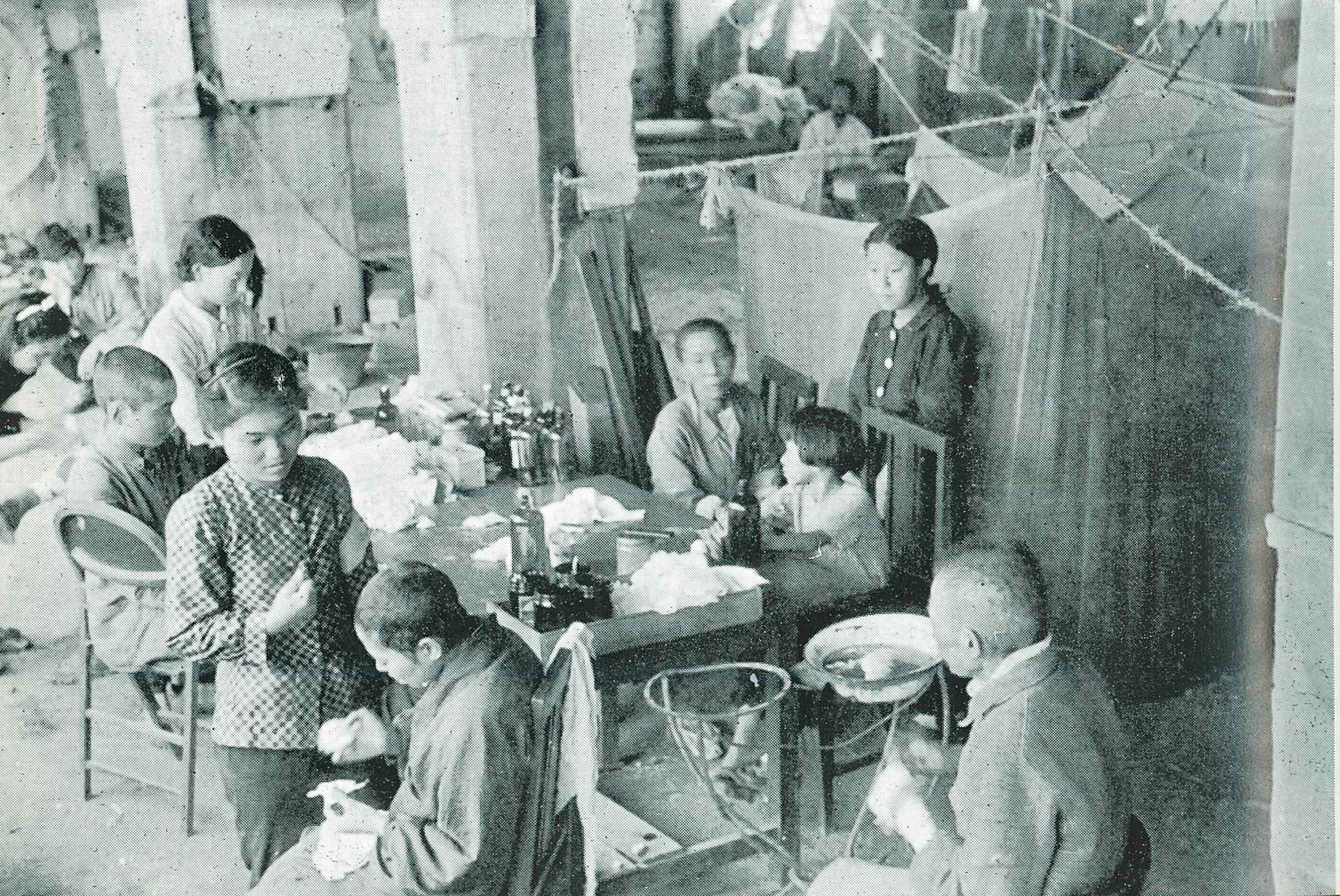
  Immediately after the Nagasaki atomic bomb was dropped and exploded, the Nagasaki City Medical Association and other relief teams began medical relief activities from the area around the hypocenter. The main relief stations in the old city center of Nagasaki were the Shinkozen Elementary School relief station and the Katsuyama Elementary School relief station. The relief stations on the opposite shore were Inasa Elementary School, Mitsubishi Hospital (main hospital), and Goshinji Temple. In northern Nagasaki, a private house in Hiramune (now Nameshi 1-chome) was used as a relief station. In the surrounding area, the families of veteran military doctors were notably rescued.

  Only an hour or two after the Nagasaki atomic bomb exploded, Nagasaki Medical College employees began treating the injured who had been exposed to the bomb in the hills behind Nagasaki Medical College Hospital. Four to five hours later, the first team of the Isahaya Naval Hospital rescue team began treating the injured who had been exposed to the bomb at Irabayashi Elementary School. A rescue team from the Omura Naval Hospital and a rescue team from the National Obama Clinic (Obama Town Rescue Team) also entered the hypocenter area of Nagasaki City and carried out rescue activities.

  In Nagasaki City, dedicated relief efforts were carried out in and around the hypocenter immediately after the bombing. However, the scope of their activities was limited to a few areas. The arrival of relief teams was delayed under the worst possible conditions, with frequent air raid warnings and American fighter planes flying overhead. The start of full-scale medical relief activities was also delayed until August 10, the day after the Nagasaki atomic bomb was dropped. from August 10, relief teams from inside and outside Nagasaki Prefecture, including many Marine and Army relief teams and relief teams from various universities, arrived in the disaster area and were able to provide active relief. The organization of the relief units of the Imperial Japanese Navy and the Imperial Japanese Army gave priority to Nagasaki natives selected as officers and medics. It appears that soldiers from Nagasaki who worked under their command were also enlisted. The IJN and Japanese Army relief units mobilized to work in the devastated, bombed-out city of Nagasaki, university relief teams, and relief teams from inside and outside of Nagasaki Prefecture were engaged in relief efforts.


Saturday, September 23, 2023

A 3-year-old Japanese girl was burned by the Nagasaki atomic bomb, and walked around with a bandage on her head on September 29, 1945. She was injured near her destroyed home, about 1.9 kilometers south of the hypocenter of the Nagasaki atomic bomb.

  A 3-year-old Japanese girl was burned by the explosion of the Nagasaki atomic bomb dropped by the U.S. Air Force on August 9, 1945, in Nagasaki, Japan. She walked around with a bandage on her head after being injured near her destroyed home about 1.9 kilometers south of the Nagasaki bomb's hypocenter. A Japanese girl plays in the ruins of the collapsed Nagasaki Shinsei (U.S. National Archives and Records Administration, Photo #290036_Box 570_RG111SC, https://www.nichimyus.jp/). A U.S. Army Air Force unit inspected, photographed, and documented the city of Nagasaki after it was hit by the atomic bomb.


 The detonation of the atomic bomb resulted in the appearance of a huge fireball. The fireball was about 100 times brighter than the sun and its center was several million degrees Celsius. The fireball was about 100 times brighter than the sun, and its center was several million degrees Celsius. It released intense heat rays, fierce blasts, and enormous amounts of radiation, and instantly set a wide area on fire, centered on the hypocenter. The heat rays caused the surface temperature of the ground at the hypocenter to reach approximately 3,000 to 4,000 degrees Celsius. The intense heat rays caused severe burns to the survivors, and many people were killed or injured. Fires that broke out immediately after the bombing also caused extensive damage and destruction.

 Damage caused by the Nagasaki atomic bomb (estimated by the end of December 1945)* The estimated population of Nagasaki City at that time was approximately 240,000 (rationed population as of May 31, 1945), of which 73,884 were killed and 74,909 were injured. (Report of the Committee for the Preservation of Atomic Bomb Materials (released in July 1945)) A girl who suffered burns on her head from the Nagasaki atomic bomb was searching and rummaging around in the rubble ground of the ruined Nagasaki City.


Friday, September 15, 2023

This photo was taken on October 8, 1945, approximately two months after the Hiroshima atomic bomb was dropped, at the Fukuromachi Relief Hospital, where outpatients exposed to the bomb were treated. The Fukuromachi National School, located at a close distance of approximately 460 meters southeast of the hypocenter, played an important role in the relief efforts immediately after the atomic bomb was dropped.

    A patient being treated at the Fukuromachi Relief Hospital on October 8, 1945, about two months after the Hiroshima atomic bomb was dropped (Shunkichi Kikuchi). The Fukuromachi National School, located at a close distance of approximately 460 meters southeast of the hypocenter of the Hiroshima atomic bomb, played an important role in the relief efforts immediately after the bombing; the school building was completely destroyed by the Hiroshima atomic bomb after being expanded in 1937. The reinforced concrete buildings of the newly built West School survived with their outer shells intact. Of the approximately 160 children who remained at Fukuromachi Elementary School, which had not been evacuated, 157 died as a result of the atomic bombing, and 16 teachers and staff were also killed by the bomb. 3 children were exposed to the bomb inside the west school building and later evacuated to the basement, where they survived.

    On August 7, the day after the Hiroshima atomic bomb was dropped and exploded on August 6, the school was converted to a temporary relief station. On October 5, 1945, about two months later, the relief organization was changed and the Fukuromachi Relief Hospital was established as the Japan Medical Association Hospital. The number of relief stations in Hiroshima City was also reorganized into seven. By this time, the number of residents in Hiroshima had decreased and the number of outpatients had reached a critical point. As of October 5, there were 11 temporary first-aid stations in Hiroshima City, with approximately 500 inpatients and 1,200 outpatients exposed to the atomic bombing.

 Shunkichi Kikuchi took vivid photographs of the devastation in Hiroshima immediately after the bombing. The negative film of his photography survives in good condition and was kept by his wife Tokuko, who lives in Nerima Ward, Tokyo. The total number of A-bomb documentary photographs taken by a single photographer reached 783, the largest number ever recorded by a single photographer. He accompanied the documentary film production team of the "Special Committee for Investigation and Research on the Atomic Bomb Disaster," organized by the former Ministry of Education, and was in charge of taking still photographs from October 1 to October 20, 1945. He captured vivid scenes of the immediate aftermath of the atomic bombing, including patients with burns and radiation injuries receiving treatment at Hiroshima Red Cross Hospital and Hiroshima Telecommunications Hospital, and parents and children dying at Oshiba National School and Fukuromachi National School, which served as relief hospitals.


Friday, September 8, 2023

On October 15, 1945, two months after being exposed to the Hiroshima atomic bomb on August 6, 1945, signs of reconstruction appeared near Yokogawa Station, about 1,800 meters from the hypocenter. Barracks of temporary huts made of wood and tin sheets began to appear among the burnt rubble.

  On October 15, 1945, two months after the Hiroshima atomic bomb exploded on August 6, 1945, signs of reconstruction appeared near Yokogawa Station, located approximately 1,800 meters from the hypocenter. Barracks, temporary huts made of wood and tin sheets, began to appear among the burnt rubble, and a black market appeared in front of Yokogawa Station and other areas where people could easily gather. Although the temporary huts and black markets were accompanied by security and sanitation problems, they also symbolized the beginning of reconstruction. In the scene around Yokogawa Station, I photographed signs that the A-bombed city of Hiroshima and its citizens were beginning to recover.

 After the termination of the Wartime Disaster Relief and Protection Act, there was no special assistance for A-bomb survivors, and they could only rely on the general welfare system, such as the Public Assistance Act. Living in barracks built from materials left over from the fire, the survivors suffered from a shortage of supplies, making their lives extremely difficult. Barracks were the name given to temporary structures built on vacant lots or on burned-out areas after disasters. Hut-sized dwellings built by impoverished A-bomb survivors in vacant lots and other locations were called barracks. 


 At Yokogawa Station, the heat rays from the atomic bomb set one section of the station on fire, and within a few hours the station building was destroyed by fire. It is said that about 10 people were buried alive in the waiting room and only four were rescued, and on the day of August 6, a train carrying victims was operated amid the smoldering sleepers on the tracks. On August 8, two days after the bombing, the Sanyo Line of the Japan National Railways resumed operations between Hiroshima and Yokogawa stations. Immediately after the atomic bomb exploded, citizens of Hiroshima evacuated in the direction far from the hypocenter. Citizens near Yokogawa Station headed north, those near Hiroshima Station headed east or north, those near Hijiyama headed south or east, and some citizens headed in different directions due to family or work circumstances.

 For 75 years after the atomic bombing, it was rumored that nothing would grow in Hiroshima City. But Hiroshima did not die. Lifelines of transportation, communication, and electricity were quickly restored. People and supplies were transported. The supply of information and energy was also secured. The reality of the A-bomb survivors was not adequately conveyed, and discrimination and prejudice against them arose. The A-bomb survivors were trying their best to survive while enduring harsh living conditions.


Friday, September 1, 2023

A junior high school boy exposed to the Hiroshima atomic bomb, who suffered burns on his face and hands, went to the Hiroshima Red Cross Hospital, about 1,500 meters from the hypocenter, for treatment on or about August 10. The burns on both eyes were disinfected with tweezers by Dr. Koichi Nagata, chief of the Department of Obstetrics and Gynecology.

  A junior high school boy who was exposed to the Hiroshima atomic bomb by the explosion suffered burns on his face and hands, and on or about August 10, he went to the Hiroshima Red Cross Hospital in Senda-machi, Hiroshima City, located approximately 1,500 meters from the hypocenter, for treatment. The burns on both eyes were disinfected with tweezers by Dr. Koichi Nagata, chief of the Department of Obstetrics and Gynecology. The junior high school boy was feared to have lost his sight due to visual impairment caused by the burns on both eyes. With limited medical supplies, the treatment was limited to applying antiseptic solution. Many A-bomb survivors were brought to the Hiroshima Red Cross Hospital, which remained unburned, immediately after the bombing.

     Although Hiroshima Red Cross Hospital was an army hospital at the time, it also treated civilians on an outpatient basis. Although the hospital had a stockpile of medical supplies, it was quickly depleted by the influx of A-bomb survivors. A junior high school boy received outpatient treatment at the front entrance of the main building of the Hiroshima Red Cross Hospital. Both of his hands were severely burned, resulting in peeling skin and blisters. Treatment of the burns was limited to applying antiseptic, Mercuro, and olive oil, and then applying a bandage to wipe and wrap the burns. The boy was exposed to the heat rays of the Hiroshima atomic bomb from the front of his face. The boy, who followed the burns from his forehead to his cheeks and the backs of his hands, received outpatient treatment at Hiroshima Red Cross Hospital. His right arm was supported by a close relative nearby.

  The boy was a student at Hiroshima Prefectural Hiroshima Second Middle School, located approximately 1,790 meters from the hypocenter, and second-year students were instructed to gather at the Higashi Nerihei Field, approximately 2.5 km from the hypocenter, on August 6 to weed the school potato fields.

 On the morning of August 6, the first graders of Hiroshima Prefectural Hiroshima Second Middle School, consisting of six classes, were in the former Nakajima Shinmachi, approximately 500 meters from the hypocenter. Under the National Mobilization Law, they were mobilized to work on evacuating buildings in the Nakajima area, east of the New Ohashi Bridge (now the Nishi Heiwa Ohashi Bridge) over the Honkawa River. Just before the boys were lined up and their teachers finished their instruction, the Hiroshima atomic bomb was dropped and exploded. The boys were instantly blown away and hit by a vortex of fire. On the morning of the 7th, the father's corpse had already swollen up and took on a similar appearance. The boys, who reached home with burns all over their bodies and were taken to the relief station, all fell from near death to atomic bomb casualties. Approximately 344 students and eight faculty members who were at the site of Nakajima's mobilization were inscribed on the Cenotaph for the Atomic Bomb Victims at Hiroshima Prefectural Hiroshima Daini Junior High School, located on the left bank of the Honkawa River.


The boy was admitted to a hospital in Nagasaki after the atomic bombing. Even five months after the explosion on August 9, 1945, he was still suffering from severe burns and keloids (Bring Back the Human Being, 1982).

    The boy was admitted to a hospital in Nagasaki after the atomic bombing. Even five months after the explosion on August 9, 1945, he suff...